
Introduction: Is Your Business Prepared for a Cyberattack?
Technology has become one of the most important drivers of business growth. From automating daily operations to improving customer experiences, strengthening cybersecurity, and enabling data-driven decisions, the right technology can help organizations become more efficient, competitive, and scalable.
Yet many businesses invest in technology without a clear long-term plan.
They purchase software to solve immediate problems, upgrade infrastructure when something fails, introduce new applications without considering existing systems, and adopt digital tools without defining how success will be measured.
Over time, these decisions can create disconnected systems, rising IT costs, operational inefficiencies, and missed growth opportunities.
The solution is not necessarily to buy more technology. It is to make better technology decisions.
This is where a technology roadmap becomes essential.
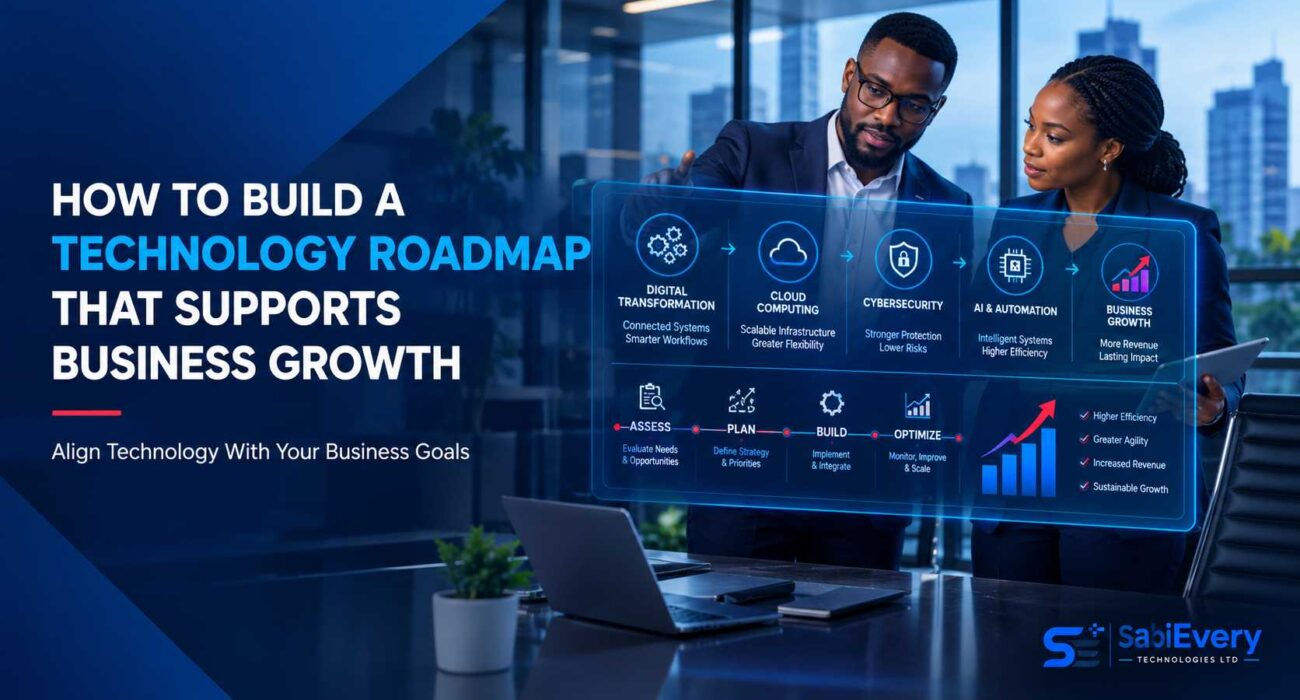
A well-designed technology roadmap helps organizations connect their business objectives with the technology, people, processes, and investments required to achieve them. It establishes priorities, defines implementation timelines, manages risks, and provides a practical framework for sustainable growth.
For Nigerian businesses operating in an increasingly competitive digital economy, technology planning is no longer simply an IT responsibility. It is a strategic business priority.
In this article, Sabievery Technologies explains how to build a technology roadmap that supports business growth, improves operational performance, and prepares your organization for the future.
What Is a Technology Roadmap?
A technology roadmap is a strategic plan that outlines how an organization will use technology to achieve its business objectives over a defined period.
It identifies the current technology environment, the desired future state, the gaps that must be addressed, and the initiatives required to bridge those gaps.
A technology roadmap typically covers:
- Business goals and technology priorities.
- Existing IT infrastructure and applications.
- Digital transformation initiatives.
- Cloud adoption and infrastructure modernization.
- Cybersecurity and risk management.
- Enterprise applications and workflow automation.
- Data management and business intelligence.
- Budget requirements and resource allocation.
- Implementation timelines and dependencies.
- Performance indicators and expected business outcomes.
A technology roadmap is different from a simple list of IT projects.
An IT project list may tell you which systems need upgrading. A technology roadmap explains why those upgrades matter, how they support business goals, when they should happen, and how their impact will be measured.
For example, a company planning to expand into new markets may need scalable cloud infrastructure, integrated customer relationship management software, stronger access controls, and reliable business analytics.
A technology roadmap connects these initiatives into a coordinated plan that supports the company’s expansion strategy.
Why Does Your Business Need a Technology Roadmap?
Without a clear technology strategy, businesses can end up spending money on solutions that do not address their most important challenges.
A structured roadmap provides several benefits.
- Aligns Technology Investments With Business Goals
Every technology investment should support a defined business objective.
If your goal is to increase revenue, your priorities might include customer relationship management, sales automation, e-commerce capabilities, or improved customer analytics.
If your goal is to reduce operational costs, you might prioritize workflow automation, infrastructure optimization, or the consolidation of overlapping software applications.
A roadmap helps decision-makers evaluate technology investments according to their expected business value.
- Improves Operational Efficiency
Manual processes, disconnected applications, and repetitive administrative tasks can slow down business operations.
A technology roadmap helps identify opportunities to automate workflows, integrate systems, and improve information sharing across departments.
This can reduce unnecessary duplication, improve turnaround times, and allow employees to focus on higher-value responsibilities.
- Supports Business Scalability
Technology that works for a small team may struggle when the organization expands.
More customers, employees, transactions, and locations can place additional demands on infrastructure and applications.
A roadmap helps organizations anticipate these requirements and plan for scalable systems before growth exposes existing weaknesses.
- Strengthens Cybersecurity and Business Resilience
Growth introduces new technology dependencies and potential risks.
As businesses adopt cloud services, connect remote employees, and integrate more applications, they must consider how information will be protected and how critical services will be restored during disruptions.
A technology roadmap incorporates security, backup, disaster recovery, access management, and risk mitigation into the broader business strategy.
- Improves Budget Planning and Decision-Making
Technology projects compete for limited financial and human resources.
A roadmap helps management distinguish urgent requirements from optional improvements, plan investments in phases, and anticipate ongoing costs.
Instead of reacting to technology problems one at a time, businesses can make informed decisions based on priorities, risks, and expected outcomes.
7 Steps to Build a Technology Roadmap That Supports Business Growth
Step 1: Define Your Business Objectives
The first step is to understand where your business wants to go.
Before selecting software, upgrading infrastructure, or investing in automation, define the outcomes your organization wants to achieve.
Consider the following questions:
- Are we planning to increase revenue?
- Do we want to expand into new markets?
- Are we trying to reduce operational costs?
- Do we need to improve customer service?
- Are our employees spending too much time on manual tasks?
- Do we need stronger cybersecurity and compliance controls?
- Are our existing systems capable of supporting future growth?
Turn these objectives into measurable targets wherever possible.
For example, a company may want to reduce customer response times, shorten invoice processing cycles, improve sales visibility, or reduce avoidable IT downtime.
These objectives provide a basis for evaluating technology opportunities.
Practical tip: Start with three to five major business objectives. Too many priorities can make your roadmap difficult to manage and dilute the impact of your investments.
Step 2: Assess Your Current Technology Environment
Once your business goals are clear, assess the technology you currently use.
This process is often called a technology assessment or IT audit. It helps identify existing capabilities, weaknesses, unnecessary complexity, and opportunities for improvement.
Your assessment should cover:
IT infrastructure: Review servers, computers, networks, storage, connectivity, and other essential infrastructure.
Business applications: Identify the systems used for accounting, human resources, sales, procurement, customer management, and daily operations.
Cybersecurity: Examine access controls, endpoint protection, network security, data backups, vulnerability management, and incident response arrangements.
Cloud services: Review existing cloud platforms, subscriptions, configurations, costs, and opportunities for optimization.
Business processes: Identify manual activities, repetitive tasks, information bottlenecks, and workflows that could be simplified.
Data and reporting: Determine whether management can access accurate, timely information to support business decisions.
People and skills: Assess employee readiness, technical capabilities, training requirements, and available resources.
The objective is to understand what is working, what is not working, and what needs to change.
For example, a business may discover that its sales team uses one application, its finance team uses another, and management relies on manually prepared spreadsheets to understand overall performance.
The resulting delays and inconsistencies may indicate a need for better system integration or a more suitable enterprise application.
Practical tip: Document your findings before recommending new technology. The right solution should address a verified business need rather than introduce another system without a clear purpose.
Step 3: Identify Technology Gaps and Opportunities
With your current environment documented, compare it with the capabilities your business needs to achieve its objectives.
This comparison reveals the gaps between your present situation and your desired future state.
For example:
| Business challenge | Potential technology initiative | Expected outcome |
| Repetitive administrative work | Workflow automation | Faster processes and fewer manual errors |
| Limited customer visibility | Customer relationship management (CRM) | Better sales tracking and customer engagement |
| Disconnected departments | Enterprise application integration | Improved information sharing |
| Rising infrastructure costs | Cloud and infrastructure optimization | Better resource utilization |
| Security weaknesses | Cybersecurity improvement programme | Reduced risk exposure |
| Slow management reporting | Business intelligence and analytics | Better-informed decisions |
| Unreliable data recovery | Backup and disaster recovery improvements | Greater business continuity |
These are examples rather than universal recommendations. The appropriate initiatives will depend on your business requirements, current systems, budget, and risk profile.
When evaluating opportunities, consider the potential business impact, implementation effort, cost, dependencies, and risks.
You should also identify whether existing systems can be improved or integrated before purchasing replacements.
Sometimes, optimizing what you already own can deliver more value than introducing an entirely new platform.
Step 4: Prioritize Projects Based on Business Value
Not every technology initiative needs to happen immediately.
A common mistake is trying to implement too many projects at once. This can stretch budgets, overwhelm employees, create integration challenges, and delay expected benefits.
Instead, prioritize initiatives according to their urgency and value.
A useful approach is to group projects into three categories.
High priority: Initiatives addressing critical security risks, major operational disruptions, urgent compliance requirements, or significant business bottlenecks.
Medium priority: Initiatives expected to improve productivity, reduce recurring costs, strengthen reporting, or support near-term expansion.
Long-term priority: Initiatives that may require additional preparation, investment, organizational maturity, or new capabilities, such as advanced analytics and selected AI applications.
You can also assess each initiative against five criteria:
- Business impact.
- Implementation cost.
- Risk reduction.
- Time required to deliver value.
- Organizational readiness.
A project with high business impact and manageable implementation requirements may be a strong candidate for early delivery. A complex project with uncertain benefits may require additional analysis before approval.
However, critical security and compliance requirements should not be delayed simply because their financial return is less immediately visible.
Practical tip: Choose a manageable number of high-value initiatives for the first phase. Delivering a few well-selected projects successfully can build confidence and create momentum for the wider roadmap.
Step 5: Develop a Realistic Technology Implementation Timeline
After prioritizing projects, organize them into a phased implementation plan.
The timeline should account for dependencies, available resources, procurement, technical requirements, employee training, testing, and expected business disruption.
A practical technology roadmap might use the following structure.
Phase 1: Foundation and assessment — Months 1–3
- Complete the technology assessment.
- Confirm business priorities.
- Address critical security weaknesses.
- Review backup and recovery arrangements.
- Identify quick opportunities for process improvement.
- Develop project budgets and implementation requirements.
Phase 2: Modernization and integration — Months 4–6
- Improve infrastructure reliability.
- Implement selected cloud or infrastructure improvements.
- Integrate priority business applications.
- Introduce workflow automation where appropriate.
- Strengthen identity and access management.
- Train employees on new or improved systems.
Phase 3: Optimization and expansion — Months 7–9
- Review the performance of implemented systems.
- Improve reporting and data visibility.
- Optimize technology costs.
- Expand successful automation initiatives.
- Address remaining integration and usability issues.
Phase 4: Growth and continuous improvement — Months 10–12
- Evaluate opportunities for advanced analytics and AI.
- Prepare systems for increased business demand.
- Review cybersecurity maturity.
- Measure business outcomes.
- Update the roadmap for the next planning cycle.
This is an illustrative 12-month roadmap, not a fixed implementation schedule. Some organizations may need a shorter plan, while complex enterprise transformations may require several years.
The important principle is to establish a realistic sequence that delivers value progressively.
Step 6: Establish a Budget and Define Responsibilities
A technology roadmap must be financially realistic.
Even a well-designed strategy can fail if the organization underestimates implementation costs, ongoing subscriptions, training, maintenance, or support requirements.
Your budget should consider:
- Hardware and infrastructure.
- Software licences and subscriptions.
- Cloud computing and storage.
- Cybersecurity tools and services.
- System integration and migration.
- Consulting and implementation.
- Employee training and change management.
- Ongoing maintenance and technical support.
- Backup and disaster recovery.
- Contingency for unexpected requirements.
Evaluate the total cost of ownership rather than focusing only on the initial purchase price.
For example, a low-cost software application may require expensive customization or manual workarounds. Another solution may have a higher initial cost but reduce recurring operational effort.
Both options should be evaluated against their long-term costs and expected benefits.
Responsibilities must also be clear.
Management should provide strategic direction and approve major investments. IT teams should manage technical planning and implementation. Department heads should define operational requirements, while employees should participate in testing, training, and adoption.
Where internal expertise is limited, an experienced technology partner can provide assessment, architecture, implementation, integration, and ongoing support.
Step 7: Measure Results and Continuously Improve
A technology roadmap should be reviewed regularly to ensure that its initiatives continue to support business goals.
Before implementing a project, establish a baseline so that you can compare performance before and after the change.
Useful indicators may include:
- Operational efficiency: Time required to complete important business processes.
- Cost optimization: Changes in IT operating costs and spending efficiency.
- Employee productivity: Reduction in repetitive work and manual data entry.
- Customer experience: Response times, service quality, and customer satisfaction.
- System reliability: Availability, downtime, and incident resolution times.
- Cybersecurity: Vulnerability remediation, access reviews, and incident response performance.
- Technology adoption: Employee usage, training completion, and user feedback.
- Business growth: Changes in revenue, customer acquisition, capacity, or other relevant commercial measures.
Choose metrics that directly relate to the purpose of each initiative.
For example, if your objective is to improve customer service through CRM implementation, measuring the number of licences purchased is not enough. You should also evaluate whether customer records are more accessible, follow-ups are more consistent, and service performance has improved.
Review progress monthly or quarterly, depending on the scale and complexity of the programme.
If business priorities change, update the roadmap accordingly. A roadmap should provide direction without becoming so rigid that it prevents the organization from responding to new opportunities or risks.
Example: What a Technology Roadmap Could Look Like for a Growing Nigerian Business
Consider a Nigerian distribution company that wants to expand into additional markets.
Its existing operations depend on spreadsheets, manual inventory records, disconnected accounting software, and email-based customer communication.
As orders increase, management begins experiencing inventory inconsistencies, slow reporting, and difficulty tracking customer relationships.
Instead of purchasing several new applications immediately, the company develops a technology roadmap.
First priority: Stabilize operations and protect information.
The company reviews its infrastructure, secures important accounts, improves backups, and establishes clearer IT support procedures.
Second priority: Improve operational visibility.
It evaluates suitable business applications and integrates priority sales, inventory, and accounting processes.
Third priority: Automate repetitive activities.
The company introduces selected workflow automation to reduce duplicate data entry and improve order processing.
Fourth priority: Improve management decisions.
It establishes reporting that helps management understand sales performance, stock movement, customer activity, and operational bottlenecks.
Fifth priority: Prepare for expansion.
It reviews system capacity, access controls, connectivity, support arrangements, and scalability requirements before entering new markets.
The business can then evaluate progress against measurable indicators, such as order processing time, inventory accuracy, reporting speed, operating costs, and customer response times.
The example illustrates an important principle: technology investments become more effective when they are connected to a defined business objective and implemented in a logical sequence.
Common Mistakes to Avoid When Building a Technology Roadmap
Even organizations with good intentions can struggle with technology planning. Avoid these common mistakes.
Buying Technology Before Understanding the Problem
A new application may look impressive, but it will not automatically solve a poorly understood business challenge.
Define the problem, establish the desired outcome, and evaluate available options before committing to a solution.
Treating Technology as an IT-Only Responsibility
Technology affects finance, operations, sales, customer service, human resources, and leadership.
Involve the departments that will use the systems and the managers responsible for the outcomes.
Ignoring Cybersecurity and Business Continuity
Security should not be postponed until after new systems are deployed.
Include appropriate protection, backup, recovery, access management, and risk assessment in project planning from the beginning.
Underestimating Employee Adoption
Employees may resist unfamiliar systems or continue using old processes if they do not understand the benefits.
Provide practical training, communicate changes clearly, and involve users in implementation.
Failing to Plan for Integration
Disconnected applications can create data silos and additional manual work.
Assess how new systems will exchange information with existing platforms before implementation.
Setting Unrealistic Budgets and Timelines
Technology projects can involve data migration, testing, integration, procurement, and change management.
Allow sufficient time and resources to implement solutions properly.
Measuring Activity Instead of Business Results
Completing an installation is not the same as achieving business value.
Measure whether the technology improves efficiency, security, customer experience, decision-making, or another defined objective.
How Sabievery Technologies Supports Technology Roadmap Development
At Sabievery Technologies, we believe that technology should serve a clear business purpose.
Our approach focuses on helping organizations identify their needs, evaluate their current capabilities, prioritize investments, and implement technology solutions that support measurable business outcomes.
Through our digital transformation consulting services, we support technology roadmap development, business process re-engineering, IT governance, change management, and digital adoption.
Our broader capabilities include:
Digital transformation consulting: Align technology initiatives with organizational goals and develop a structured approach to modernization.
Enterprise applications: Support business processes through ERP, customer relationship management, HR management, financial management, procurement, and document management solutions.
Cloud solutions: Help organizations assess cloud migration, infrastructure deployment, hybrid cloud environments, backup, and disaster recovery requirements.
Cybersecurity solutions: Strengthen security through risk assessments, vulnerability management, endpoint protection, identity and access management, network security, and security awareness.
IT infrastructure and managed services: Support reliable infrastructure, system monitoring, technical support, and ongoing technology optimization.
AI and intelligent automation: Help organizations identify appropriate opportunities to automate processes, improve access to information, and support data-driven decisions.
These services can be coordinated according to an organization’s priorities, resources, and growth objectives rather than treated as unrelated technology purchases.
To learn more, visit Sabievery Technologies and explore our Digital Transformation Consulting, Enterprise Applications, Cloud Solutions, and Managed Services.
Conclusion: Turn Your Technology Strategy Into a Growth Plan
A technology roadmap gives your business a clearer path from its current capabilities to its future ambitions.
By defining business objectives, assessing existing systems, identifying gaps, prioritizing initiatives, planning investments, and measuring results, your organization can make better technology decisions and reduce the risks associated with uncoordinated IT spending.
For Nigerian businesses, a structured roadmap can also help address practical challenges involving operational efficiency, cybersecurity, connectivity, technology costs, and organizational readiness.
You do not need to transform every part of your business at once.
Start with your most important business goals. Identify the technology improvements that will make the greatest difference. Implement them in manageable phases, measure their impact, and continuously improve your approach.
The goal is not to have the most technology. The goal is to have the right technology, implemented at the right time, to deliver the right business outcomes.
Ready to Build a Technology Roadmap for Your Business?
Let Sabievery Technologies help you develop a practical technology strategy aligned with your business goals.
Whether you want to modernize your IT infrastructure, improve cybersecurity, automate business processes, adopt cloud solutions, or prepare your organization for expansion, a well-planned roadmap can help you move forward with greater clarity and confidence.
Contact Sabievery Technologies Ltd.
- Website: https://sabieverytechnologies.com/
- Email: info@sabieverytechnologies.com
- Phone: +234 814 967 3682
- Office: 6B, Adeniyi Jones Street, Ikeja, Lagos, Nigeria.
Sabievery Technologies — Technology. Solutions. Value.