

Cloud computing is changing the way businesses operate.
From storing documents and managing customer information to running business applications, websites, accounting systems, communication platforms, and databases, businesses can now access powerful technology without having to maintain all the infrastructure themselves.
For businesses in Nigeria, cloud migration can create opportunities to reduce infrastructure burdens, improve accessibility, support business growth, and strengthen operational resilience.
However, moving to the cloud is not as simple as uploading your files and switching off your physical servers.
A successful cloud migration requires planning.
Before moving your business systems to the cloud, you need to understand your existing technology, your data, your costs, your connectivity, your security requirements, and your regulatory responsibilities.
In this two-part guide, we will explain what Nigerian businesses should consider before beginning a cloud migration.
In Part 1, we will focus on the fundamentals: what cloud migration means, why businesses are moving to cloud, and some of the most important issues you should consider before making the move.
What Is Cloud Migration?
Cloud migration is the process of moving a company’s digital systems, applications, data, and IT infrastructure from traditional environments into cloud-based environments.
Depending on the organization, this could involve moving:
- Business applications
- Company documents and files
- Databases
- Email systems
- Customer information
- Accounting software
- Websites and web applications
- Backup systems
- Enterprise applications
- Internal business platforms
Cloud migration does not necessarily mean moving everything at once.
For some businesses, gradual migration is safer and more practical.
Others may benefit from a hybrid approach where some systems remain on premises while other workloads operate in the cloud.
The important thing is to choose an approach based on your business requirements.
Why Are Nigerian Businesses Moving to the Cloud?
Businesses are increasingly looking for ways to become more flexible, efficient, and digitally connected.
Cloud technology can help support these goals.
- Reduced Infrastructure Burden
Traditional IT infrastructure can require businesses to purchase and maintain physical servers, storage equipment, networking equipment, backup systems, and other hardware.
This also comes with costs associated with maintenance, power, cooling, physical security, and technical support.
Cloud services can reduce the amount of physical infrastructure a business needs to maintain internally.
- Easier Business Growth
As a business grows, its technology requirements often grow with it.
You may need more storage, additional users, greater computing capacity, or new applications.
Cloud platforms can make it easier to scale resources according to changing business requirements.
- Remote Access
Modern businesses increasingly have employees, clients, contractors, or teams working from different locations.
Cloud-based systems can allow authorized users to access applications and information from different locations, subject to appropriate security controls.
This can be particularly useful for businesses operating across multiple offices or supporting remote teams.
- Backup and Disaster Recovery
Businesses depend heavily on their digital information.
A server failure, hardware problem, cyberattack, accidental deletion, or physical incident can disrupt operations and potentially cause significant data loss.
Cloud-based backup and disaster-recovery strategies can provide an additional layer of protection.
However, businesses should remember that simply storing information in the cloud does not automatically create a complete disaster-recovery strategy.
Backup and recovery still need to be properly designed and tested.
- Access to Modern Technology
Cloud platforms can give businesses access to technologies that may otherwise require substantial investment in infrastructure.
These can include:
- Data analytics
- Artificial intelligence
- Automation
- Scalable databases
- Cybersecurity tools
- Business intelligence
- Collaboration platforms
For growing Nigerian businesses, this can create opportunities to adopt modern technology without building every component from scratch.
Don’t Move Everything Just Because You Can
One of the biggest mistakes businesses can make is treating cloud migration as a simple “move everything” project.
Not every application needs to move.
Not every workload is ready to move.
And not every business problem can be solved by moving to the cloud.
Instead of asking:
“How do we move everything to the cloud?”
Ask:
“Which systems should move, why should they move, and what is the safest and most cost-effective way to move them?”
Some applications may be ready for migration.
Others may need to be updated or redesigned first.
Some legacy systems may also have dependencies that need to be understood before they are moved.
That is why assessment should come before migration.
5 Things Nigerian Businesses Should Consider Before Cloud Migration
- Assess Your Existing IT Environment
Before selecting a cloud provider, understand what you already have.
Create an inventory of yours:
- Applications
- Servers
- Databases
- Business files
- Users
- Devices
- Network infrastructure
- Integrations
- Backup systems
- Security controls
Then identify which systems are critical to daily operations.
This gives you a clearer picture of what needs to be migrated, replaced, redesigned, or retained.
Without this assessment, businesses can easily overlook important dependencies.
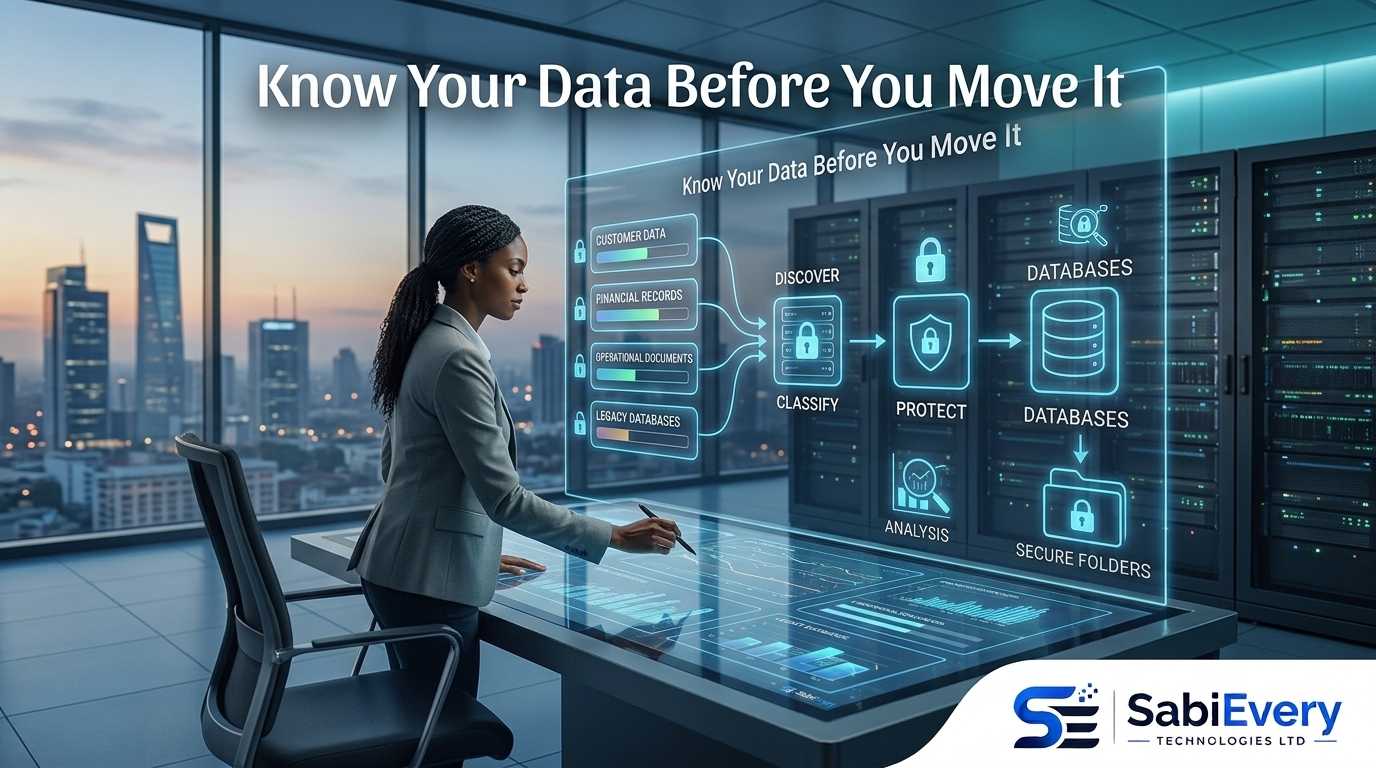
- Understand Your Data
Not all business information is of the same level of importance.
Your organization may have:
- Public information
- Internal business documents
- Confidential information
- Financial records
- Customer information
- Employee information
- Sensitive personal data
These categories should be considered when designing your cloud environment.
For Nigerian businesses, data protection is especially important.
The Nigeria Data Protection Act (NDP Act) 2023 establishes obligations around the responsible processing and protection of personal data.
This means businesses should consider privacy and data protection before migrating personal information rather than treating compliance as something to address after migration.
Your migration plan should consider:
- What data is being moved
- Why the data is being moved
- Who can access it
- How it will be protected
- Where it will be stored
- How long should it be retained
- How it will be deleted when no longer required
- Know Where Your Data Will Be Hosted
Cloud services do not mean that your data exists in one generic location called “the cloud.”
Depending on your provider and configuration, your information may be stored in specific geographic regions.
Businesses should understand:
- Where primary data will be stored
- Where backups will be stored
- Who can access the information
- How the information is encrypted
- What happens during an outage
- Whether information crosses national borders
- What contractual protections are available
This is particularly important for organizations processing personal data.
Nigeria’s data-protection framework includes requirements relating to international transfers of personal data, so businesses should consider cross-border data arrangements when planning cloud infrastructure.
The growing availability of local cloud and data-Centre infrastructure in Nigeria also gives businesses additional options to evaluate when designing their technology environment.
- Calculate the Real Cost of Cloud
Cloud computing is often promoted to reduce IT costs.
It can reduce certain infrastructure costs, but cloud services are not automatically cheaper.
Businesses should calculate the complete cost of operating their proposed cloud environment.
Consider:
- Cloud subscriptions
- Computing resources
- Storage
- Data transfer
- Backup
- Security services
- Software licenses
- Migration services
- Technical support
- Monitoring
- Staff training
- Application redesign
- Disaster recovery
For example, a business may migrate an application to the cloud and later discover that unused resources are generating monthly charges.
Cloud cost management therefore needs to be part of the migration plan from the beginning.
- Plan for Internet Connectivity
Connectivity is one of the most important considerations for businesses operating cloud-based systems.
If employees depend on cloud applications to perform their daily work, internet connectivity becomes an important part of business continuity.
Before migration, evaluate:
- Your primary internet connection
- Backup connectivity
- Available bandwidth
- Office network infrastructure
- Wi-Fi performance
- VPN requirements
- Remote-user connectivity
- Failover arrangements
Ask an important question:
What happens to your business if your primary internet connection goes down?
For businesses that depend heavily on cloud applications, having an alternative connectivity option can reduce operational disruption.
Cloud infrastructure may be highly resilient, but your organization still needs a reliable connection to access it.
The Bottom Line
Cloud migration can offer Nigerian businesses significant opportunities to modernise their technology, improve accessibility, scale more efficiently, and strengthen business resilience.
But successful migration starts with preparation.
Before moving anything, understand your existing technology, classify your data, consider your regulatory responsibilities, calculate the real cost, and evaluate your connectivity.
Most importantly, don’t treat cloud migration as simply an IT exercise.
It is a business transformation project.
What Comes Next?
In Part 2, we will look at the next stage of cloud migration planning, including:
- Cloud security
- Employee readiness
- Choosing between public, private, hybrid, and multi-cloud
- A practical cloud migration roadmap
- Common migration mistakes
- A cloud-readiness checklist for Nigerian businesses
Read Part 2: Cloud Migration in Nigeria — How to Prepare, Migrate and Avoid Common Mistakes.
About Sabievery Technologies
Sabievery Technologies helps businesses leverage technology to improve operations, modernize their digital infrastructure, and build a stronger foundation for growth.
If your organization is considering cloud migration or broader digital transformation, proper planning is the first step.