
The rapid evolution of Nigeria’s digital economy has moved business infrastructure far beyond the walls of traditional, physical server rooms. Cloud mobility represents the ability to seamlessly move applications, workloads, and data across private, public, and hybrid cloud environments without operational disruption.
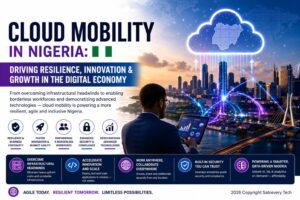
For Nigerian enterprises historically constrained by rigid, on-premise hardware, this fluid movement of data marks a profound architectural shift. This transformation allows local organizations to break free from geographic limitations and scale their digital operations dynamically. Overcoming Infrastructural HeadwindsOperating a physical data centre in Nigeria introduces severe operational overhead due to persistent power grid instabilities and high diesel generator costs.


Cloud mobility offers a strategic escape from these physical bottlenecks by shifting the burden of uptime to resilient, world-class cloud infrastructure. By migrating critical assets to the cloud, local businesses completely eliminate the need for massive upfront capital expenditure on hardware. This asset-light model transforms predictable monthly operating expenses into a powerful shield against local infrastructure failures. Consequently, organizations can redirect their capital toward core business growth rather than maintaining depreciating physical assets.Accelerating Innovation and Market AgilityIn a highly competitive and fast-evolving market, the speed at which a company can deploy new software determines its market dominance. Cloud mobility allows software development teams across Nigeria to spin up testing environments in minutes rather than weeks.

This agility enables local fintechs, logistics companies, and retailers to roll out updates and features at a global pace. Companies are no longer held back by the slow procurement timelines of physical server delivery and configuration. By building on flexible cloud frameworks, Nigerian businesses can rapidly prototype, test, and launch innovative products that address local challenges.Empowering a Borderless, Productive WorkforceThe modern Nigerian workforce increasingly demands flexible, remote, and hybrid working arrangements to bypass intense urban commuting challenges. Cloud mobility securely extends the corporate perimeter, allowing employees to access heavy enterprise applications from any connected device.


Teams can collaborate in real time on shared files, databases, and customer management pipelines from any location nationwide. This democratization of data access significantly lifts daily operational productivity while reducing traditional office overhead costs. Furthermore, it allows Nigerian companies to attract and retain top-tier talent living outside major economic hubs like Lagos or Abuja. Cultivating Business Continuity and Resilience Unexpected macroeconomic shifts, local supply chain disruptions, or localized physical disasters can completely halt standard business operations.


Cloud mobility serves as the ultimate insurance policy by decoupling corporate data from a single physical point of failure. Automated multi-region backups ensure that if a local node goes offline, operations immediately failover to another cloud zone. This near-instantaneous recovery capability protects critical financial transactions, user profiles, and operational logs from permanent loss. For sectors like banking and aviation, this level of resilience is mandatory for maintaining continuous consumer trust and regulatory compliance.


Strengthening enterprise security compliance as the Nigeria Data Protection Commission (NDPC) tightens regulatory oversight, strict data security and privacy compliance have become non-negotiable requirements. Modern mobile cloud ecosystems embed advanced security architectures, including automated threat detection, end-to-end encryption, and multi-factor authentication. These platform-level guardrails shield sensitive enterprise datasets against the rising tide of sophisticated local and international cyber threats. Centralized cloud management also prevents data leaks by giving IT administrators total visibility over who accesses corporate assets.
By leveraging compliant cloud hyperscale’s, local firms inherently inherit international security benchmarks that would be cost-prohibitive to build on-premise. Democratizing Advanced Emerging Technologies, Small and medium enterprises (SMEs) across Nigeria have traditionally been locked out of high-end analytical tools due to prohibitive costs.

Cloud mobility levels the playing field by providing on-demand access to advanced Artificial Intelligence, Machine Learning, and Big Data processing. Local businesses can analyze complex market trends, consumer habits, and supply chain loops using pay-as-you-go cloud analytics tools. This accessibility enables a startup in Enugu or a retail chain in Kano to make data-driven decisions just like a global multinational. Ultimately, cloud mobility fosters a highly inclusive digital ecosystem where raw innovation, rather than budget size, dictates market success.

Thank you
2026 Copyright Sabievery Tech

Leave A Comment

All fields marked with an asterisk (*) are required