Introduction: The Next Evolution of Business Technology
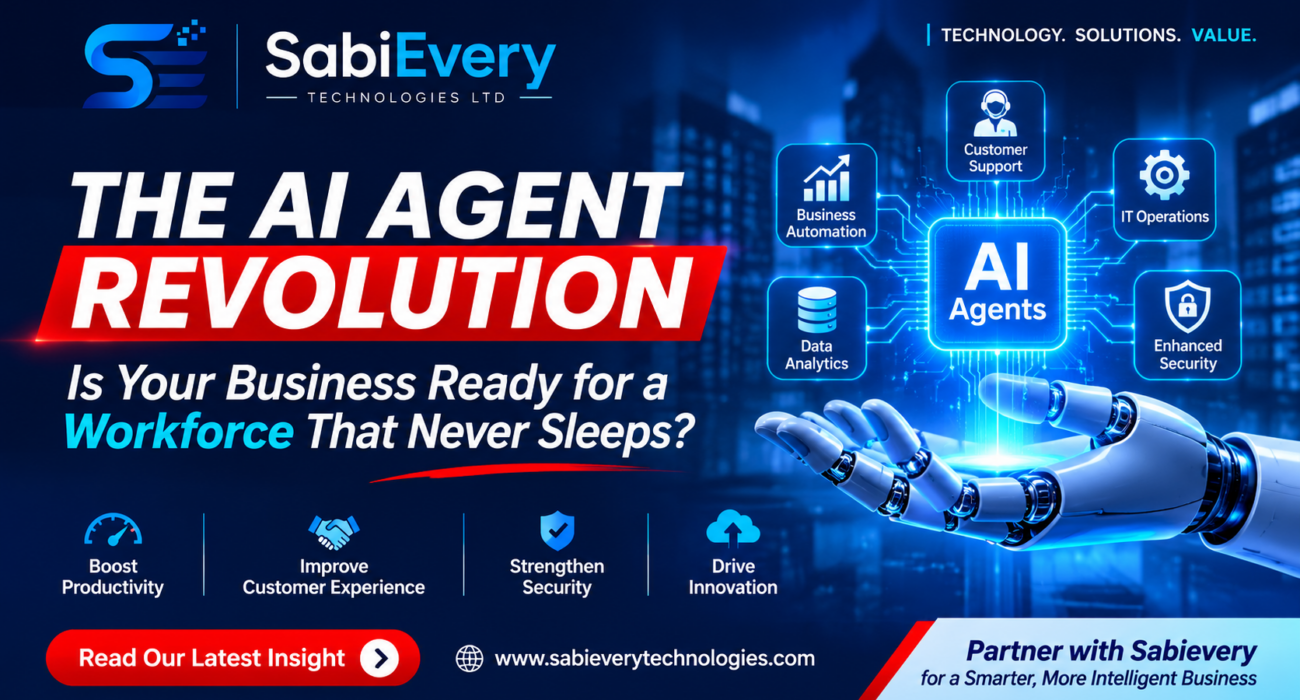
Artificial Intelligence is changing the way organizations operate. However, the next major shift is no longer just about asking AI questions, generating reports or creating content.
Businesses are entering a new era where AI agents can perform tasks, coordinate workflows, interact with business applications and execute instructions with varying levels of autonomy.
Imagine an AI-powered system that can monitor customer enquiries, organize support requests, generate reports, identify operational issues and coordinate repetitive administrative activities without requiring an employee to initiate every individual task.
This is the emerging reality of agentic AI.
For business leaders, the question is no longer simply whether to adopt artificial intelligence. It is whether their organizations have the infrastructure, security, governance and operational readiness to manage intelligent systems working alongside human employees.
What Exactly Are AI Agents?
AI agents are intelligent software systems designed to pursue specific objectives, understand context, use available tools and execute multiple steps towards completing assigned tasks.
Unlike traditional automation, which generally follows predefined instructions, AI agents can adapt their actions to changing situations within their assigned permissions.
For example:
- Customer service: An AI agent can classify enquiries, retrieve relevant information and prepare responses.
- IT operations: AI agents can monitor systems, identify unusual activities and assist with incident resolution.
- Business administration: They can organize documents, summarize information and coordinate repetitive workflows.
- Sales operations: They can support lead qualification, customer follow-ups and sales reporting.
- Data management: They can collect information, identify patterns and prepare business insights.
The real opportunity lies in connecting these capabilities to the systems businesses already use.
Why Businesses Are Paying Attention to Agentic AI
The growing interest in AI agents reflects a broader shift towards autonomous business operations.
Gartner’s October 2026 research identified AI agents as a major development in infrastructure and IT operations, predicting that by 2030, 50% of organizations will use AI agents with minimal human involvement in IT operations.
This signals a significant change in how businesses will manage technology, productivity and service delivery.
For organizations, potential benefits include:
1. Improved operational efficiency
AI agents can handle repetitive, time-consuming activities, allowing employees to focus on more strategic responsibilities.
2. Faster business processes
Tasks that previously required several manual steps can be coordinated through intelligent workflows.
3. Better customer experiences
Businesses can use AI agents to support faster enquiry handling, information retrieval and customer service operations.
4. Improved IT operations
AI agents can assist technology teams with monitoring, troubleshooting, incident analysis and routine maintenance.
5. More effective use of business information
By connecting authorized data sources, AI agents can help organizations turn operational information into actionable insights.
The Hidden Risks: What Happens When AI Agents Make Mistakes?
While the opportunities are significant, autonomous systems introduce new operational and security challenges.
An AI agent with excessive permissions could modify business information, access sensitive resources or initiate actions beyond its intended responsibilities.
Gartner reported in November 2026 that 95% of surveyed infrastructure and operations leaders had experienced at least one agent-related incident during the preceding 12 months.
The message is clear: adopting AI without appropriate governance creates unnecessary business risks.
Organizations should pay attention to five important areas:
1. Access control and permissions
AI agents should only access the applications, information and resources required to perform their assigned duties.
2. Data protection
Sensitive business information must be protected against unauthorized access, exposure and inappropriate processing.
3. Human oversight
High-impact decisions, financial transactions and sensitive operational changes should have appropriate human approval.
4. Monitoring and accountability
Organizations need visibility into what their AI agents are doing, which systems they access and what actions they perform.
5. Business continuity
Businesses must prepare for unexpected agent behaviour, system failures and operational disruptions.
AI governance should be treated as an essential part of enterprise technology strategy, not an afterthought.
Is Your IT Infrastructure Ready for AI Agents?
Before introducing AI agents into business operations, organizations should evaluate their existing technology environment.
Consider the following questions:
- Are your business applications properly integrated?
- Do you have clearly defined user permissions and access policies?
- Is your business data organized, protected and accessible to authorized systems?
- Can your IT infrastructure support additional AI workloads?
- Do you have monitoring and incident response capabilities?
- Are employees prepared to work alongside intelligent systems?
Businesses that overlook these foundations may struggle to move from AI experimentation to reliable enterprise deployment.
A successful AI strategy requires more than purchasing an AI subscription. It requires the right combination of infrastructure, enterprise applications, security, integration and professional guidance.
The Role of Technology Partners in the AI Transition
As AI agents become increasingly integrated into business environments, organizations will need technology partners who understand both the opportunities and the risks.
A capable technology partner can help businesses assess infrastructure readiness, identify automation opportunities, implement appropriate enterprise solutions and establish security controls.
At Sabievery Technologies Ltd, we believe technology investments should deliver measurable business value.
From IT infrastructure and enterprise applications to cybersecurity, cloud solutions, digital transformation and technology consultancy, businesses need solutions that work together to support sustainable growth.
The objective should not be to automate everything simply because automation is possible. It should be to identify where intelligent technology can improve business performance while maintaining control, security and accountability.
Conclusion: The Future Workforce Will Be Human and Intelligent
AI agents are introducing a new dimension to business productivity.
Organizations that understand how to integrate intelligent systems responsibly may gain advantages in efficiency, responsiveness and operational performance.
However, the organizations that succeed will not necessarily be those adopting the most AI tools. They will be those that combine intelligent automation with strong infrastructure, appropriate governance and clear business objectives.
The AI agent revolution is already taking shape.
Is your business preparing for it, or waiting until the competition gets ahead?
Let’s Build a Smarter Business
Ready to explore how AI, enterprise applications, automation and modern IT infrastructure can improve your business operations?
Partner with Sabievery Technologies Ltd to identify the right technology solutions for your organization.
Website: https://sabieverytechnologies.com
Email: info@sabieverytechnologies.com
Phone: +234 814 967 3682
Sabievery Technologies Ltd — Technology. Solutions. Value.