

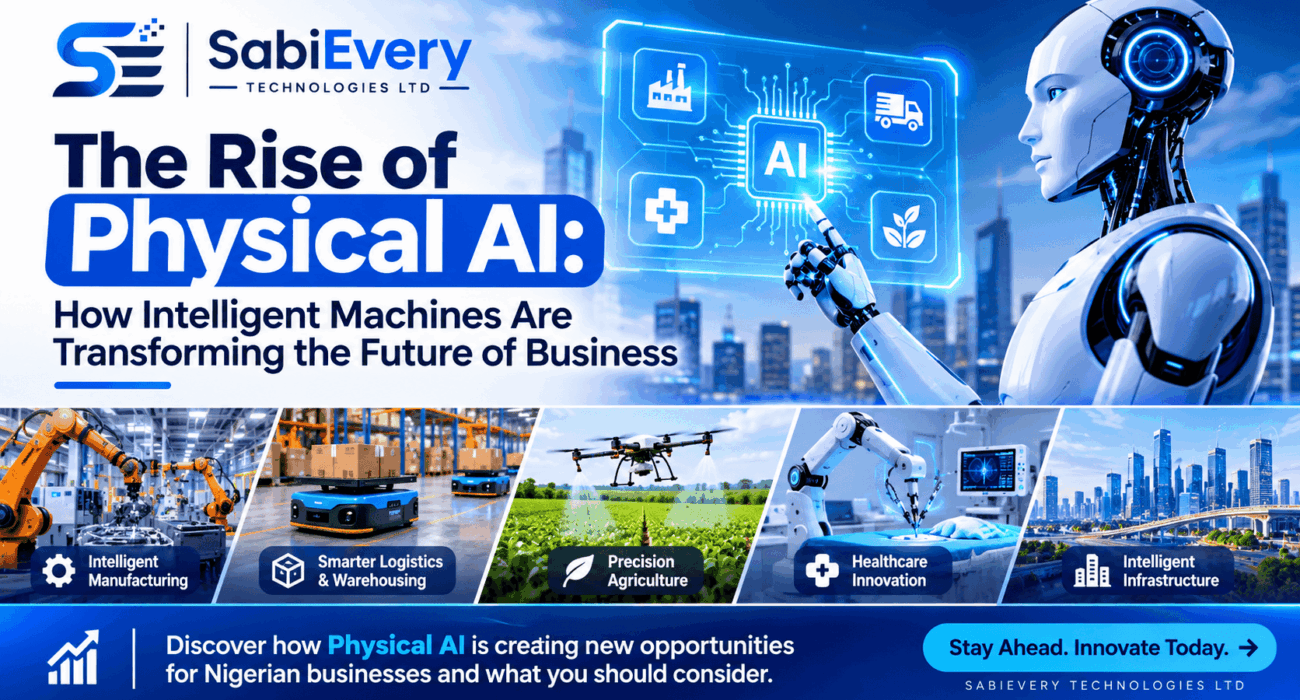
Introduction: When Artificial Intelligence Moves Beyond the Screen
Artificial Intelligence is entering a new phase.
For years, discussions around AI have focused on chatbots, automated customer support, content generation and software-based decision-making. However, a new development is changing how businesses think about the technology: Physical AI.
Physical AI combines artificial intelligence with machines, robotics, sensors and connected systems, allowing technology to interact with and respond to the physical world.
Unlike traditional software that processes information and provides recommendations, Physical AI enables machines to understand their surroundings, interpret information and perform physical tasks.
From intelligent manufacturing equipment and autonomous warehouse robots to precision agriculture and advanced healthcare systems, this technology is creating new possibilities for businesses across different industries.
The question for business leaders is no longer simply whether AI can improve office productivity. It is how intelligent machines could transform the way their organizations operate.
What Exactly Is Physical AI?
Physical AI refers to AI-powered systems that can perceive, understand and interact with their physical environments.
These systems typically combine several technologies:
- Artificial Intelligence: Enables machines to process information, recognize patterns and make decisions.
- Robotics: Provides the physical capability to perform tasks.
- Internet of Things (IoT): Connects machines and sensors to collect and exchange information.
- Computer Vision: Allows machines to interpret visual information from their surroundings.
- Edge Computing: Enables data processing closer to where it is generated, supporting faster responses.
When these technologies work together, machines can perform tasks with greater levels of autonomy, adaptability and precision.
Five Ways Physical AI Could Transform Business Operations
1. Intelligent Manufacturing
Manufacturing organizations can use intelligent robotic systems to support assembly, inspection, material handling and quality control.
AI-powered machines can identify production irregularities, recognize defects and respond to changing operational conditions.
This could help manufacturers improve production consistency, reduce material waste and increase operational efficiency.
2. Smarter Logistics and Warehousing
Warehouses and distribution centres are increasingly exploring autonomous mobile robots and intelligent systems to support inventory movement, sorting and order fulfilment.
These technologies can help organizations improve warehouse visibility, optimize internal movement and reduce repetitive manual activities.
For businesses managing large inventories and distribution networks, this represents an opportunity to rethink operational efficiency.
3. Precision Agriculture
Agriculture is another sector with significant potential.
AI-powered machines, drones, sensors and automated equipment can support crop monitoring, soil analysis, irrigation management and agricultural operations.
For agricultural businesses, these technologies could improve resource utilization and provide better information for operational decisions.
4. Healthcare and Medical Technology
Physical AI is also creating opportunities in healthcare through intelligent medical equipment, robotic-assisted procedures, automated laboratory systems and advanced patient monitoring.
These technologies can support healthcare professionals, improve operational processes and contribute to more precise medical procedures.
5. Intelligent Infrastructure and Facilities Management
Businesses can also benefit from intelligent systems that monitor equipment, identify unusual operating conditions and support predictive maintenance.
For example, connected sensors and AI-powered monitoring systems can help organizations identify potential equipment problems before they result in significant operational disruption.
This can improve asset management, reduce avoidable downtime and support business continuity.
What Nigerian Businesses Should Consider Before Adopting Physical AI
Although the technology offers exciting opportunities, successful adoption requires more than purchasing intelligent machines.
Organizations need to establish the right technological foundation.
Here are five important considerations:
1. Infrastructure Readiness
Physical AI systems depend on reliable connectivity, computing resources, networks and supporting infrastructure. Organizations must assess whether their existing IT environments can support these requirements.
2. Data Management
Intelligent systems rely on accurate, relevant and accessible data. Businesses need effective data collection, integration, storage and management strategies.
3. Cybersecurity
Connected machines introduce additional digital access points. Organizations must consider network security, device protection, identity management and continuous monitoring.
4. Workforce Readiness
Employees need appropriate training to operate, supervise and work alongside intelligent systems. Technology adoption should be supported by effective change management.
5. Business Value and Return on Investment
Businesses should identify specific operational challenges before investing. Technology adoption should be driven by measurable business outcomes rather than the excitement surrounding a new innovation.
The Role of IT Infrastructure in the Physical AI Era
One important consideration is that Physical AI does not operate independently.
Behind every intelligent machine is a technological ecosystem involving infrastructure, networks, data platforms, software, security and system integration.
Organizations seeking to explore these technologies must pay attention to the reliability and scalability of their underlying IT environments.
This is where strategic technology planning becomes essential.
Businesses need technology partners capable of helping them assess infrastructure requirements, strengthen their digital environments, integrate enterprise systems and establish secure foundations for future innovation.
Conclusion: Preparing for the Next Phase of Business Technology
Physical AI represents an important development in the evolution of enterprise technology.
As intelligent machines become more capable, organizations will have new opportunities to rethink manufacturing, logistics, agriculture, healthcare and infrastructure management.
However, the businesses that benefit most will not necessarily be those that adopt the newest technology first. They will be those that understand their operational needs, prepare their infrastructure and implement technology with clear business objectives.
For Nigerian businesses, now is the time to begin understanding what this emerging technology could mean for their industries.
The future of business technology is not limited to what happens on a computer screen. Increasingly, it will also involve how intelligently our physical environments operate.
Is your business prepared for the next generation of intelligent technology?
At Sabievery Technologies Ltd., we help organizations modernize, secure and scale their technology environments through IT infrastructure, enterprise applications, cybersecurity, cloud solutions and digital transformation consulting.
Let’s discuss how your organization can prepare for the future of business technology.
Contact Sabievery Technologies Ltd.
Website: https://sabieverytechnologies.com
Email: info@sabieverytechnologies.com
Phone: +234 814 967 3682
Technology. Solutions. Value.